Lead Yourself First: Why the Best Leaders Master Themselves Before They Lead Others
There is no shortage of leadership advice today.
Walk into any bookstore, scroll through social media or browse YouTube and you'll find thousands of videos, books and courses promising to make you a better leader. They teach communication, decision-making, accountability, influence and strategy.
Those things matter.
But what if we've skipped the most important lesson?
What if leadership doesn't begin when you're promoted?
What if it begins much earlier?
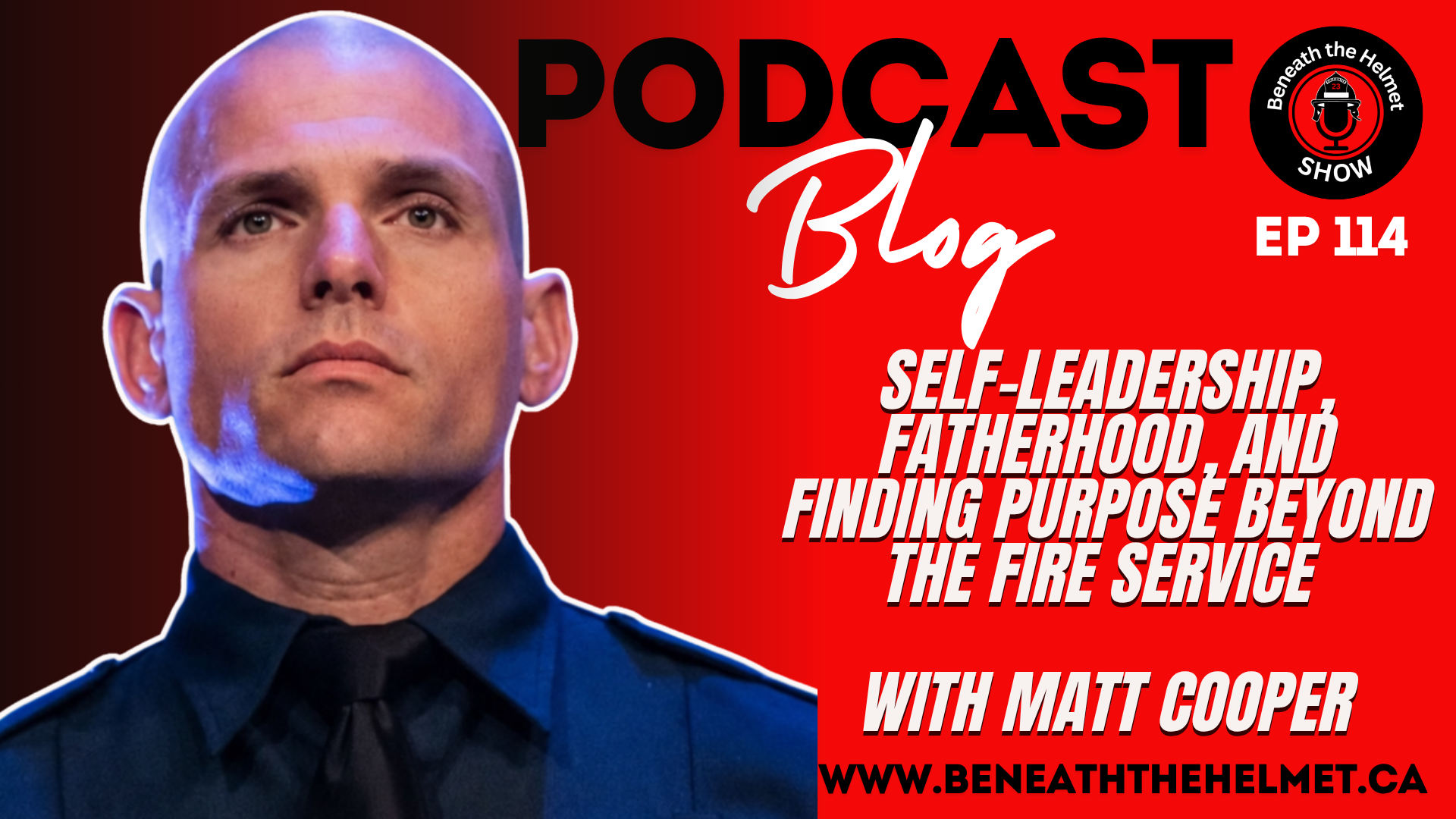
That question sits at the heart of my conversation with firefighter, author and father Matthew Cooper.
What started as a discussion about his book, In Case I Don't Come Home: Letters to My Son, quickly became one of the most thoughtful conversations we've had on Beneath the Helmet. It wasn't really about writing a book. It was about becoming the kind of person your children, your crew and your community deserve to follow.
We Spend Too Much Time Learning How to Lead Others
And not enough learning how to lead ourselves.
Matthew shares a simple but profound idea.
Leadership isn't built on tactics.
It's built on character.
He described leadership as a pyramid.
Too many of us race toward the top. We read leadership books, study communication techniques and search for the perfect strategy.
Meanwhile, the foundation remains unfinished.
That foundation is self-mastery.
If we haven't learned to regulate our emotions, understand our purpose, examine our motives and develop discipline, every leadership technique we learn is built on unstable ground.
This deeply aligns with something I've come to believe in my own work.
Self-leadership isn't another leadership topic.
It is the leadership topic.
Silence Isn't Empty
It's Where We Meet Ourselves.
One of the most compelling parts of our conversation centred on silence.
Not meditation.
Not productivity.
Just silence.
Matthew described waking before sunrise, sitting quietly with a journal, allowing himself to think before the world demanded his attention.
No phone.
No notifications.
No scrolling.
No noise.
Just space.
That simple practice transformed his life.
As firefighters, we're conditioned to move.
Respond.
Fix.
Solve.
React.
Stillness often feels uncomfortable.
But perhaps that's exactly why we need it.
Because silence has an interesting way of introducing us to ourselves.
The Hidden Cost of Constant Distraction
One of Matthew's observations struck me deeply.
He described how alcohol and endless scrolling weren't the real problems.
They were simply distractions from thoughts he didn't want to hear.
Many of us don't struggle because we're too busy.
We struggle because we're never truly present.
Every spare moment gets filled.
Another email.
Another video.
Another podcast.
Another project.
Another task.
Busyness has become socially acceptable avoidance.
I've lived this.
For years, I convinced myself I was always "improving."
Reading another book.
Taking another course.
Listening to another leadership expert.
Eventually I realized something.
Growth also requires space.
Sometimes the most productive thing we can do is simply sit quietly and think.
Character Is Built in Ordinary Moments
The most emotional story Matthew shared wasn't from a fireground.
It wasn't a dramatic rescue.
It wasn't a near miss.
It was helping his young son after he became sick and was overwhelmed with embarrassment.
Matthew didn't see inconvenience.
He saw opportunity.
An opportunity to show unconditional love.
An opportunity to demonstrate safety.
An opportunity to teach his son that mistakes don't reduce his worth.
Leadership rarely arrives wearing bunker gear.
More often, it arrives disguised as ordinary moments.
Playing with Hot Wheels.
Helping someone off the floor.
Listening without interrupting.
Being fully present.
Those moments shape us far more than we realize.
Purpose Is Stronger Than Pleasure
Another powerful idea from our conversation was Matthew's belief that purpose sustains us when pleasure disappears.
If our lives revolve around comfort, entertainment or dopamine, suffering leaves us empty.
But when our lives revolve around serving something larger than ourselves—our families, our communities, our crews—we can endure far greater hardship because our purpose remains.
As first responders, that's an important reminder.
Purpose doesn't remove suffering.
It gives suffering context.
What This Means for Leaders
Leadership development shouldn't begin with influence.
It should begin with integrity.
Before asking:
How do I motivate my crew?
Perhaps we should first ask:
How well do I lead myself?
Before asking:
How do I earn trust?
Perhaps we should ask:
Am I trustworthy?
Before asking:
How do I become respected?
Perhaps we should ask:
Am I living in a way worthy of respect?
Those are harder questions.
They're also the ones that matter most.
Top 5 Leadership Nuggets
After reflecting on this conversation, these are the five lessons I'll carry forward.
1. Self-leadership comes first.
Leadership begins long before someone wears bugles or bars.
2. Make room for silence.
The answers we're looking for often arrive after the noise disappears.
3. Character grows quietly.
It's built through thousands of ordinary decisions.
4. Purpose protects us.
Service creates resilience.
5. Leadership starts at home.
How we show up for our families says as much about our leadership as how we show up on the fireground.
Matthew's book may be written to his son.
But its lessons are for all of us.
Whether you're leading a department, raising children or simply trying to become a better human being, this conversation offers an invitation that is increasingly rare.
Slow down, make time to think and lead yourself first.
Arjuna George - Podcast Host
www.beneaththehelmet.ca
When Showing Up Isn’t the Same as Being Present