When Showing Up Isn’t the Same as Being Present
Presence, Ambiguous Loss, Mental Maydays, and Better Conversations in the Fire Service
🎧Listen now
Firefighters become very good at showing up.
We show up for the alarm. We show up for training. We show up for overtime, committee meetings, funerals, famPresence, Ambiguous Loss, Mental Maydays, and Better Conversations in the Fire Service
Firefighters become very good at showing up.
We show up for the alarm. We show up for training. We show up for overtime, committee meetings, funerals, family dinners, birthdays, school events, and the countless other places life asks us to be.
But showing up and being present are not always the same thing.
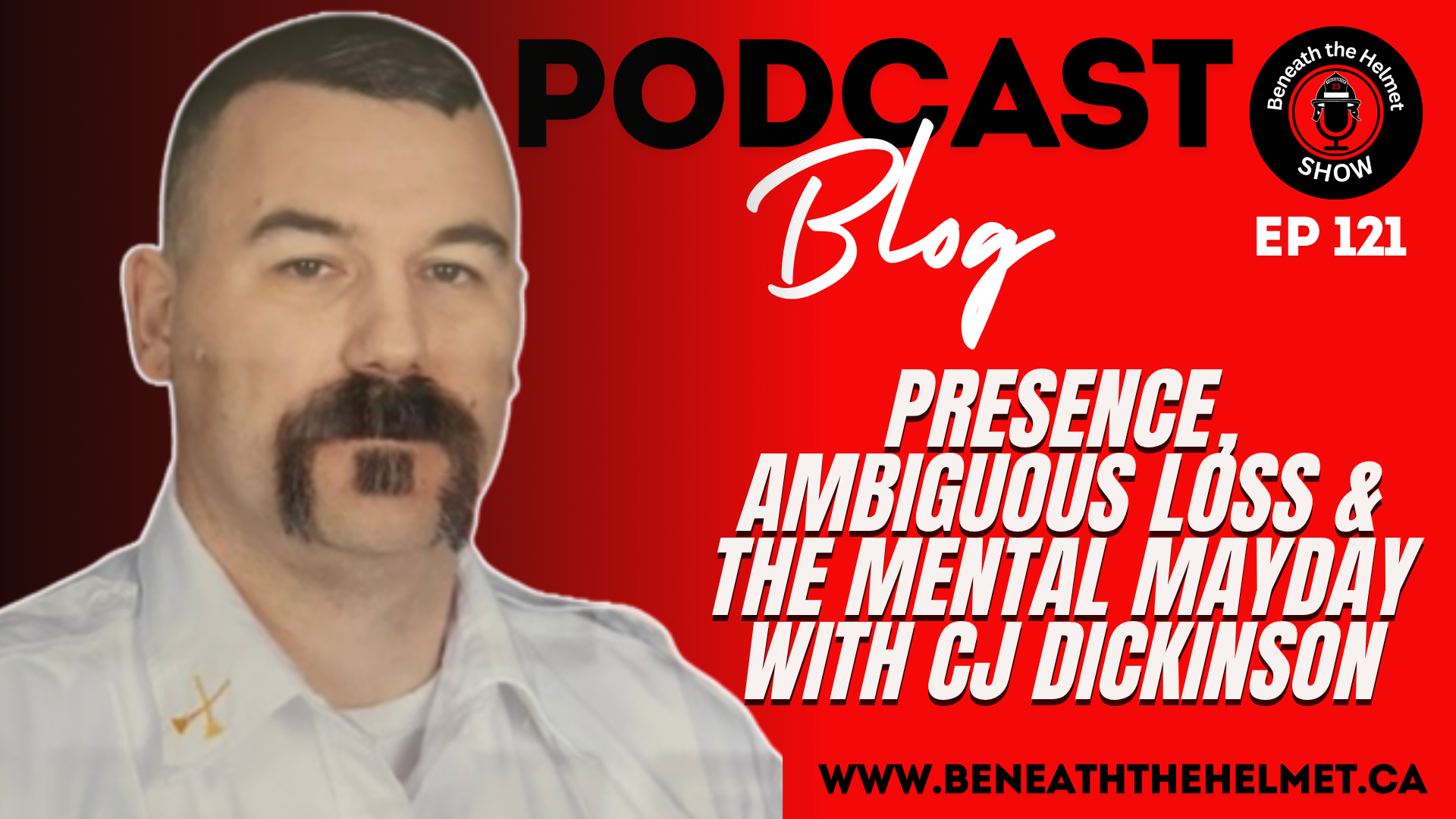
That distinction sits at the centre of my conversation with firefighter, former battalion chief, mental wellness advocate, coach, speaker, and writer CJ Dickinson on Episode 121 of Beneath the Helmet.
CJ shared openly about periods in his life when he was physically present for the people who mattered most to him, but psychologically somewhere else.
The body was there.
The mind was still carrying something.
Sometimes it was the job. Sometimes accumulated stress. Sometimes it was the internal work he hadn't been ready to face yet.
His story raises an important question for anyone working in a high-pressure profession:
How often do we go through our lives without fully being present?
Ambiguous Loss: When Someone Is There, But Not Fully There
One central idea in our conversation was ambiguous loss.
CJ described it as grief without clear closure. In the form most relevant to his experience, someone may be physically present while psychologically absent.
That can be difficult to recognize.
There may be no dramatic moment.
No obvious breaking point.
No single event that tells a family, crew, or individual, “Something has changed.”
Instead, the shift can happen quietly.
You sit at the dinner table, but your attention is somewhere else.
You attend your child’s event, but part of your mind is still back at work.
You answer the question, nod at the right moments, and go through the motions, but you are not fully connected to what is happening around you.
CJ shared a powerful example involving photographs of himself with his son.
In one photograph, he was physically there at a wrestling tournament. From the outside, it may have looked like an engaged father supporting his son.
Inside, he knew something was different.
At that time, his phone was often on Do Not Disturb. He was withdrawing from calls, messages, and communication. He continued to show up physically, but mentally and emotionally he was struggling.
Looking back, CJ could see two versions of himself in photographs taken at different points in his life.
One was present in body.
The later version was much more present as a person.
That recognition became part of his understanding of ambiguous loss and of the work he needed to do.
Sometimes Naming Something Changes Our Relationship With It
Language can add value to an experience.
CJ talked about what changed when he learned about ambiguous loss.
Before that, he knew something was happening.
His family could see it.
He could see parts of it himself.
But having language helped him understand the experience differently.
That does not mean a label fixes anything.
It does not mean every difficult season needs a diagnosis or a clinical explanation.
Sometimes language simply gives us a starting point.
It can help us move from:
“Something is wrong.”
to:
“I think I understand part of what is happening.”
That distinction matters.
When we understand something a little better, we may also be able to communicate about it more clearly.
CJ talked about this after a difficult call. He could return home and explain that something significant had happened and that he needed some space to process it.
That kind of communication gives the people around us something to work with.
It does not ask them to fix us.
It helps them understand where we are.
Families Often Notice Before We Do
One of the most important parts of the conversation was CJ’s emphasis on family.
First responder wellness conversations often focus almost entirely on the responder.
But stress rarely stays contained within one person.
It travels home.
It changes conversations.
It changes patience.
It changes sleep.
It changes how available we are to the people closest to us.
CJ made the point that family members may notice changes before coworkers do.
That makes sense.
At the fire hall, many of us know how to perform.
We arrive.
We put on the uniform.
We do the job.
We can be struggling internally and still function effectively during the shift.
Home can be different.
The people closest to us often see what happens when the armour comes off.
CJ believes fire service wellness efforts need to include families more intentionally, not so family members become therapists or peer counsellors, but so they have some understanding of what their firefighter may be experiencing and how they can support them.
That distinction matters.
Support is different from responsibility.
The people we love should not be expected to carry our recovery.
But they are often part of the environment in which healing, communication, and reconnection happen.
The Tactical Pause
One of the most practical ideas from this episode was something firefighters already understand well:
the tactical pause.
We use tactical pauses operationally.
We stop.
We reassess.
We look at conditions.
We ask whether what we are doing still makes sense.
CJ suggested that we can use the same principle when moving between roles.
You finish your shift.
You drive home.
Before you walk through the door, pause.
Ask yourself:
How do I want to show up for the people on the other side of this door?
It is a simple question.
It does not require a 45-minute meditation.
It does not require perfect emotional regulation.
It doesn't require us to pretend the shift didn't happen.
It creates a moment of awareness.
Maybe you need five minutes before walking inside.
Maybe you need to tell your partner, “It was a rough night. I’m okay, but I need a few minutes to decompress.”
Maybe you realize you are carrying irritation that belongs to work.
Maybe you notice that your family has been waiting to see you all day and that your phone can stay in your pocket for a while.
The tactical pause gives us a chance to choose our next move rather than automatically carrying one environment into another.
Presence Can Be Trained
Firefighters are trained to pay attention.
On the fireground, situational awareness can be a survival skill.
We notice smoke conditions.
We listen to radio traffic.
We track crew locations.
We watch building behaviour.
We scan constantly for changes.
But many of us have had very little training in bringing that same quality of attention into relationships.
CJ offered several simple practices.
Put the phone face down.
Turn the television off during an important conversation.
Give someone ten minutes of full attention.
Listen to understand, not just to respond.
These sound small.
They are.
That is partly why they are useful.
Presence is rarely built through one dramatic transformation.
It is built through repeated moments of attention.
“Are You Good?”
The fire service has a familiar question:
“You good?”
The equally familiar answer is:
“Yeah. I’m good.”
Sometimes that is true.
Sometimes it is the fastest possible way to end the conversation.
CJ talked about learning to listen beyond the words.
How did the person answer?
What changed in their tone?
What does their body language look like?
Is their response consistent with how they normally show up?
This is where relationships matter.
You cannot notice a meaningful change in someone if you have never taken the time to know their baseline.
That makes everyday connection part of wellness.
Knowing who someone is outside of work matters.
Their family.
Their interests.
Their goals.
What normally energizes them.
How they normally communicate.
When you know someone, you are more likely to notice when something is different.
That awareness is not about diagnosing coworkers.
It is about being human enough to ask a second question.
Maybe instead of stopping at:
“You good?”
we continue with:
“You seem a little different today. Are you okay right now?”
Then we listen.
Leadership Happens in Small Moments
One of my favourite stories CJ shared involved a question he used regularly as a battalion chief.
At the beginning of the day, he would ask members of his crew:
“How may I best support you today?”
At first, people were unsure what to do with the question.
That is understandable.
In many hierarchical environments, people are used to leaders telling them what the organization needs.
CJ flipped that direction.
He asked what they needed from him.
Over time, people began answering more openly.
They shared what they hoped to accomplish.
They talked about what support would help.
The question became part of the culture.
Then one busy morning, CJ forgot to ask it.
His crew noticed.
They turned the question back toward him.
What could they take off his plate?
That moment told him something important.
The culture had changed.
Not because of a poster.
Not because of a policy.
Not because someone announced a wellness initiative.
Because someone asked a question consistently enough that people started treating support as something reciprocal.
Culture often changes exactly that way.
One interaction at a time.
Attendance Is Not Presence
During our conversation, I asked CJ whether the fire service sometimes confuses attendance with presence.
We reward attendance.
Training records.
Committee participation.
Extra shifts.
Certifications.
Events.
Meetings.
Being seen.
But we can attend every one of those things while becoming increasingly disconnected from ourselves.
Sometimes busyness can even help us avoid what is happening internally.
If the calendar is full enough, little quiet space is left for reflection.
That can create an uncomfortable question:
Am I busy because these things truly matter to me, or because stopping would force me to notice something I have been avoiding?
There is no universal answer.
But it is worth asking.
The Difficult Conversation With Family
CJ also spoke about conversations he has had with his son.
That part of the episode mattered.
Many first responders may eventually look back and realize they were not as emotionally available to their children or partners as they wish they had been.
That realization can bring guilt.
Regret.
Grief.
The temptation may be to leave the past alone.
CJ’s perspective was different.
Have the difficult conversation.
That does not mean unloading everything onto your children.
It means being willing to acknowledge where you were.
It may sound like:
“I know I was physically there, but I don’t think I was always present in the way you needed.”
Then ask.
Listen.
Be prepared for an answer you may not like.
CJ suggested another powerful question:
“How may I show up better for you?”
That question cannot change the past.
It can change what happens next.
Coaching and the Fire Service
The second half of our conversation turned toward coaching.
CJ admitted that his first reaction to coaching was skepticism.
He thought it sounded a little ridiculous.
That changed once he experienced it.
He began receiving coaching alongside therapy and saw its impact on how he showed up for himself, his son, and his crews.
Eventually he pursued formal coach training himself.
What stood out most to him?
Listening.
Presence.
Asking better questions.
Those are not “soft” leadership skills.
They are leadership skills.
Fire officers spend enormous amounts of time solving problems.
Sometimes that is exactly what leadership requires.
But sometimes the fastest way to weaken another person’s ownership is to solve something they could solve themselves.
Coaching creates a different approach.
Instead of immediately giving the answer, ask:
What do you think?
What have you tried?
What are you missing?
What would happen if you did nothing?
What is within your control?
What is the next step?
Those questions build reflection and ownership.
The C.A.N. Framework
CJ has taken that coaching mindset and translated it into something familiar to firefighters.
The fire service already knows the CAN report:
Conditions. Actions. Needs.
CJ repurposed it for coaching:
Clarity
What is actually happening?
What is the real issue?
What are the stressors?
What assumptions are being made?
What part of the situation is within your control?
Actions
What have you tried?
What worked?
What did not?
What resources have you already used?
What options are available?
Next Steps
What are you willing to do next?
What can happen in the next 24 to 48 hours?
What is realistic?
What support might help?
The model works because it does not require firefighters to learn another complicated system.
It uses familiar language to create better conversations.
And perhaps more importantly, it slows the conversation down enough to find the real issue.
Someone might say:
“I’m exhausted because of work.”
The coaching response is not necessarily:
“Take time off.”
It might be:
“What part of work is exhausting you?”
Then go deeper.
Is it call volume?
Sleep?
Overtime?
Financial pressure?
Conflict?
Family stress?
A sick parent?
A relationship issue?
Lack of recovery?
The first answer is not always the real answer.
Sometimes we need what I call the double click.
Go one layer deeper.
Then another.
That is often where clarity starts.
What Would It Cost You to Do Nothing?
When I asked CJ what he would say to a firefighter who sees coaching as an unnecessary expense, he answered with a coaching question:
“What would it cost you if you did nothing?”
That question reaches far beyond coaching.
What is the cost of staying disconnected?
What is the cost of avoiding the conversation?
What is the cost of being physically present but psychologically absent for another five years?
What is the cost of never asking for help?
What is the cost of carrying everything alone?
Changing may also have a cost.
Difficult conversations are uncomfortable.
Reflection can uncover things we would rather avoid.
Asking for support can challenge deeply ingrained ideas about strength and competence.
Growth won't always feel comfortable.
CJ closed the episode with a familiar idea that fits the entire conversation:
Growth often requires a willingness to be uncomfortable.
A Question to Carry With You
If there is one question worth taking from this episode, perhaps it is this:
If you could press pause right now and take a closer look at one part of your life, what would it be?
Not what you should fix.
Not what is wrong with you.
Simply:
What deserves a closer look?
Maybe it is work.
Maybe it is your relationship.
Maybe it is how you transition home after a shift.
Maybe it is sleep.
Maybe it is something you have been carrying for years.
Maybe it is how present you have been with the people who matter most.
You do not need to solve everything today.
Start with clarity.
Then actions.
Then the next step.
Sometimes that is enough to begin.
Listen to Episode 121
Listen to EP121 of Beneath the Helmet with CJ Dickinson: Presence, Ambiguous Loss & the Mental Mayday.
CJ Dickinson is a firefighter, former battalion chief, mental wellness advocate, coach, speaker, and writer. In this episode, we explore ambiguous loss, presence, family connection, leadership, difficult conversations, coaching, and CJ’s C.A.N. Framework.
For more episodes and resources from Beneath the Helmet, visit www.beneaththehelmet.ca.
For coaching and leadership resources with Arjuna George, visit www.silverarrowco.com.
Five Takeaways from This Episode
Showing up physically and being genuinely present are not always the same thing.
Language can help us better understand and communicate difficult experiences.
A tactical pause can help first responders transition more intentionally from work to home.
Strong leaders listen beyond words and take time to know the people they serve.
Coaching can help people build clarity, ownership, self-awareness, and meaningful next steps.
Buy CJ's Journal CLARITY. ACTIONS. NEXT STEPS.: A DAILY COACHING AND REFLECTION JOURNAL
Buy Arjuna's Book Burnt Around the Edges: A Guide to Mastering Stress and Surviving Burnout
Your Host
Arjuna George
Tactical Brain Training for First Responders: Learning to Notice Before You React