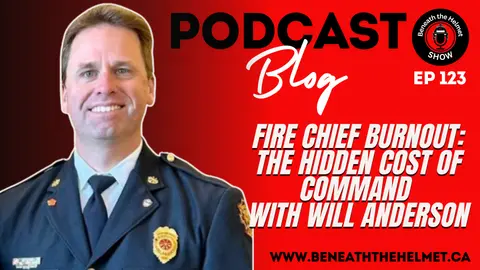
Fire Chief Burnout: The Hidden Cost of Command
Fire service leaders spend much of their careers learning how to manage emergencies, people, budgets, politics and change. Yet one of the hardest things to manage can be the cumulative effect of the role itself.
In Episode 123 of Beneath the Helmet, I sat down with Dr. Will Anderson to discuss his research on fire chief burnout. This subject matters to me personally. I left the fire service after my own experience with burnout and moral injury, and I have long believed we need a more honest conversation about what leadership can cost when responsibility continually exceeds recovery.
Will’s research helps bring some numbers to a problem many chiefs already feel.
The Job Can Follow You Everywhere
Among the 43 fire chiefs in Will’s study, 55% reported feeling burned out once a week, a few times a week or every day. Almost 90% said the job had become more demanding since they took over. Roughly 84% thought about work problems when they woke up, and 80% thought about them when they went to bed.
Those numbers describe more than a busy schedule. They describe a role that can occupy the mental space that should also belong to sleep, family, recovery and life outside the department.
Burnout Is More Than Being Tired
Burnout is often used casually to describe a hard week. The conversation with Will points to something more sustained. Emotional exhaustion, cynicism and reduced professional effectiveness can develop over time when stress remains chronic and recovery is insufficient.
For fire chiefs, that strain may not come primarily from emergency incidents. Personnel problems, labour-management issues, governance, political pressure, limited resources and the visibility of the chief’s position can become relentless.
The higher a leader moves in an organization, the more visible their decisions become. A mistake that might have remained small earlier in a career can become a department-wide or community issue. Chiefs can also find themselves between competing expectations: members want one thing, elected or administrative leaders want another, and the chief is expected to somehow satisfy both.
Lonely at the Top
One of the strongest themes in the conversation is isolation.
Will describes research participants experiencing exclusion and, in some cases, more overt hostility after moving into senior leadership. The chief may know the work of the people they lead because they once did it themselves. The reverse is not always true. Members may never see the closed-door meetings, political pressures, advocacy or compromises required behind the scenes.
That gap can create misunderstanding on both sides.
When Will asked participants what they would recommend to current and future chiefs, common answers included having an assistant chief or support staff, knowing yourself before taking the position, and building relationships with other chiefs through local, regional and professional networks.
Leadership was never meant to be carried entirely alone.
When Work Comes Home
Burnout rarely stays neatly contained inside the fire hall.
Will found both positive and negative changes in family relationships after participants became chiefs. Some families benefited from more predictable schedules. Others experienced significant strain as calls, emails, work problems and mental preoccupation followed the chief home.
This is where a simple phrase from our conversation matters: your family deserves the best of you, not the rest of you.
A career can be meaningful without receiving every remaining ounce of energy. The department existed before us and, in most cases, will continue long after we leave. Our closest relationships deserve a place in our priorities while the career is still happening, not only after retirement.
Moral Injury and the Weight of Values
We also discussed moral injury. For me, this became an important part of understanding my own burnout after leaving the chief’s role.
Moral injury is not interchangeable with burnout, and the episode does not reduce it to a single cause. The broader point is that repeated experiences that conflict with deeply held values can take a toll. Those experiences may occur during calls, within organizational culture, through leadership decisions, or when a person repeatedly feels required to act in ways that conflict with what they believe is right.
That makes values alignment an important leadership conversation. It is difficult to sustain a long career when the person, the organization and the work remain chronically at odds.
Doing the Job Differently
Will’s story is particularly interesting because he stepped away from the fire service and later returned to a chief’s position.
His second approach is intentionally different.
He told his new members they can call when something truly needs his attention, but he won't spend every evening checking email. He intends to use his time off, travel, be present for his family and keep the job in perspective.
His point is not that chiefs should care less. It is that caring deeply about the work does not require letting it consume everything else.
Five Takeaways
1. Burnout can become normalized long before a leader recognizes how much it is affecting them.
2. The inability to mentally detach from work is an important warning sign.
3. Fire chief stress often comes from people, governance, competing expectations and organizational pressure, not only emergency incidents.
4. Chiefs need support structures, trusted peers and space to be people outside the role.
5. Sustainable leadership requires boundaries, self-awareness and priorities that extend beyond the department.
A Better Definition of Success
Perhaps the larger question from this episode is how we define a successful fire service career.
Is it how much we accomplished? How many projects we completed? How available we were? How many problems we solved?
Or can success also include the quality of the person who reaches retirement, the relationships that remain, and the capacity to enjoy the life the career was supposed to help build?
Strong leadership and personal wellbeing do not need to be opposing goals. In fact, the longer I work in this space, the more convinced I am that they depend on each other.
Listen to Episode 123 of Beneath the Helmet with Dr. Will Anderson, then download the companion guide at https://www.beneaththehelmet.ca/downloads/Will-guide/
If this conversation raises questions about your own leadership, stress or burnout, learn more about my coaching work at www.silverarrowco.com.
AI Should Give Fire Service Leaders More Time for People, Not More Work