When the Uniform Becomes Your Identity: Reclaiming Life Beyond the Job
There is a point in many first responder careers when the work begins to follow you home.
It may not arrive as a crisis. It may look like always choosing the seat with a view of the door. It may sound like shorter answers at the dinner table. It may feel like being physically home while your mind is still replaying calls, reviewing decisions or scanning for what could go wrong.
Over time, the job can become more than something you do. It can begin to shape how you think, how you relate to others and how you see yourself.
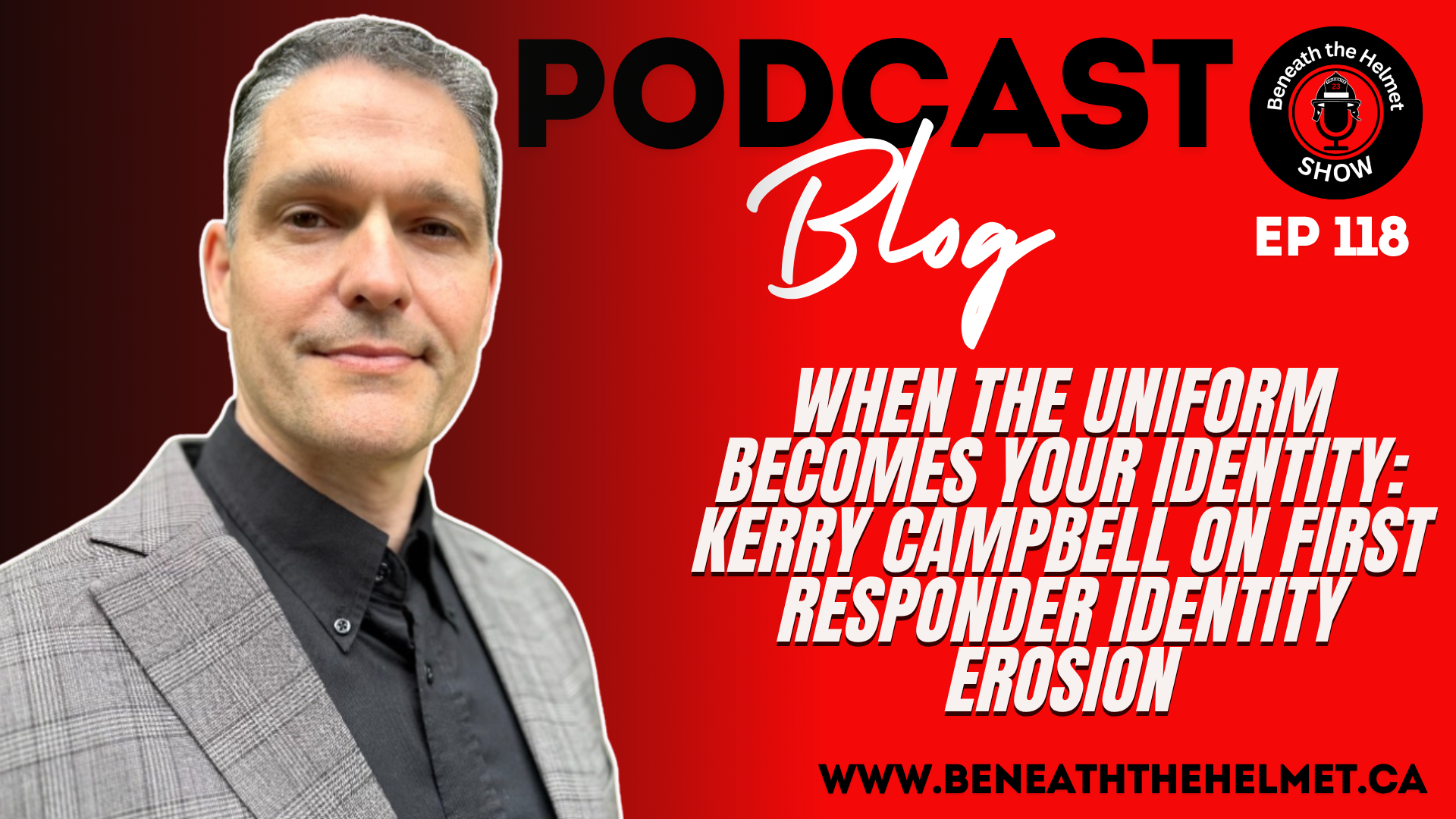
In Episode 118 of Beneath the Helmet, I spoke with Police Sergeant and mindset coach Kerry Campbell about first responder identity erosion, hypervigilance and the challenge of separating the person from the profession.
Kerry’s story matters because the changes didn't happen all at once. There was no single breaking point. The shift was gradual enough that he did not fully recognize it.
His family did.
What Is First Responder Identity Erosion?
Kerry has served as a police officer for more than two decades, working across Nova Scotia, New Brunswick and Prince Edward Island. His career has included uniform duties, drug investigations, homicide, organized crime, national security and covert operations.
He once loved policing. Then, several years ago, he reached a point where he no longer enjoyed the work and could not fully explain why. He earned his real estate licence and began preparing to leave the RCMP.
Coaching gave him a different way to understand what was happening.
The issue was not a single difficult call or a single challenging assignment. Years of vigilance, emotional control, cumulative stress and negative expectations had changed how Kerry experienced both his career and his personal life.
Policing was no longer only his profession. It had become the lens through which he experienced everything.
Identity fusion happens when the line between a person and their occupational role becomes difficult to see. The role grows larger while other parts of the person grow quieter: parent, partner, friend, neighbour, learner, or simply someone allowed to rest.
Kerry describes this as identity erosion because it develops slowly. No dramatic event signals that something is wrong. The person continues working, functioning and meeting expectations while gradually becoming disconnected from life beyond the uniform.
When Operational Strengths Follow You Home
First responders need to remain composed, assess risk, and make decisions under pressure. At an emergency scene, temporarily containing emotion may be necessary to support others and complete the task.
Hypervigilance can also be protective. Scanning an environment, noticing subtle changes and anticipating danger are valuable operational skills.
The challenge begins when those skills become the default everywhere.
Kerry spoke about positioning himself with his back to a wall in his own home so he could see the front door. He remembered taking his children to Disneyland while remaining so alert that he could not fully experience the moment with them.
His body was with his family, but his mind was still working.
His family learned to give him space when he came home. They adapted to a version of Kerry who was physically present but emotionally unavailable.
Then, as Kerry began working on himself, they noticed something different.
Dad smiled again. Dad could be fun again.
That observation is one of the episode's most powerful moments. Families often recognize the changes before the first responder does. They may adjust their behaviour, avoid certain conversations or quietly create space around the person’s stress.
Those adaptations may help the household function, but they can also hide how deeply the job has entered the home.
You Do Not Have to Wait for Rock Bottom
Kerry did not experience a dramatic rock bottom. That is part of what makes his story so valuable.
Support is often organized around visible crisis. Someone is off work, a relationship is breaking down, or burnout has made continuing impossible. Those moments deserve care, but crisis should not be the entry requirement for change.
Kerry’s message is that you can notice the pattern earlier.
He recommends asking yourself four simple questions:
* What have I been thinking about?
* How do I feel right now?
* How am I behaving?
* How am I showing up for the people around me?
This is not an exercise in self-criticism. It is an opportunity to create awareness.
When a pattern becomes visible, you have a better chance of interrupting it.
The people around you may also have important information. If a partner, child, friend or colleague says you seem distant, tense, reactive or unlike yourself, it does not have to be treated as an accusation. It may be an early signal from someone who can see a gradual change more clearly than you can.
A 90-Second Work-to-Home Transition
One of the most practical parts of my conversation with Kerry was his work-to-home transition practice.
Before leaving his vehicle, Kerry pauses briefly. He slows his breathing, notices where he is carrying tension and consciously releases what he can. He identifies three things he values in that moment, such as being home, seeing his children or sharing a meal.
He then uses a consistent action to mark the transition from duty to home.
That action can be simple:
* Changing out of work clothes
* Taking a shower
* Going for a short walk
* Pausing before entering the house
* Using another repeatable cue that says the shift has ended
Slow, controlled breathing may help reduce arousal and support regulation for some people. It is not a guaranteed reset, and it does not erase the experiences of a difficult shift.
The larger lesson is that transitions deserve intention.
Leaving the station does not automatically mean the mind and body have left work. A repeatable transition practice can help create a clearer boundary between operational demands and home life.
To help put these ideas into practice, download the free companion resource:
[More Than the Uniform: A Work-to-Home Transition Guide for First Responders](https://www.beneaththehelmet.ca/downloads/kerry-guide/)
The guide walks you through a practical process to notice what you are carrying, settle your system, reconnect with your surroundings and arrive home with greater intention.
Consistency Matters More Than Perfection
This work is not about never struggling again.
First responder careers will continue to involve pressure, uncertainty and difficult experiences. Old patterns may return. A challenging shift may still affect you.
The goal is to notice sooner, recover more effectively and prevent one difficult moment from automatically becoming a difficult week.
Kerry uses reminders throughout the day to pause and check in with himself. He also focuses on habit replacement rather than continually adding more tasks to an already full life.
A helpful question is not only, “What healthy habit should I add?”
It is also, “What pattern is taking time, energy or attention away from the person I want to become?”
Small actions repeated over time can create a new default. Missing a day does not erase the work. Returning to the practice is part of the practice.
Identity Beyond the Uniform
Identity fusion does not automatically disappear when a first responder retires. In some cases, retirement makes it more visible.
Kerry has spoken with retired first responders who continue to struggle because the uniform carried so much of their identity, structure, belonging and purpose. When the career ended, they were left asking, “Who am I now?”
Preparing for retirement is not only a financial exercise. It is also an identity practice that can begin years before the final shift.
Consider asking:
* Who am I outside my occupational role?
* Which relationships need more of my attention?
* What interests have I neglected?
* How do I want to contribute after this career?
* What kind of person do I want to be at work and at home?
These questions do not reduce commitment to service. They can help make a career more sustainable because the job no longer has to carry every source of meaning, identity and belonging.
Kerry now describes policing as a job. He does not say that with disrespect. He still loves the work and takes pride in it.
The difference is that policing is no longer everything.
That separation has helped him become more present at home and, in his experience, better at work.
My Five Takeaways From This Conversation
1. The people closest to us may notice the change first
Identity erosion can be difficult to recognize from the inside. Pay attention when the people who know you beyond the uniform say you seem distant, tense or different. Their observations may offer an early opportunity to make a change.
2. Operational strengths need an off-duty setting
Hypervigilance, emotional control and threat awareness can be essential on duty. At home, those same patterns may interfere with rest, connection and recovery. Learning to shift out of operational mode helps sustain a healthy career.
3. A transition home should be intentional
The end of a shift does not always mean you've mentally or emotionally set the job down. Even a short, repeatable transition practice can help create a boundary between work and home.
4. You do not have to wait for a crisis
Meaningful change can begin before burnout, relationship breakdown or a forced departure from the career. Wanting to become healthier, more present or more connected is reason enough to begin.
5. The job can matter deeply without becoming all of you
Pride in the profession and a healthy separation from it can coexist. A meaningful career should support your life, not erase the person beneath the uniform.
Start Before You Need To
The strongest message from this episode is not that first responders should care less about their work. It is that meaningful service does not require surrendering every other part of who you are.
You can serve with commitment and still have boundaries. You can take pride in the uniform while building a life beyond it. You can seek support before everything falls apart.
Identity erosion may happen gradually, but it is not inevitable or irreversible.
Begin with awareness. Notice what you are carrying. Listen to the people who know you beyond the job. Decide who you want to be in and out of your career.
Then practise coming home.
Listen to the full conversation with Kerry Campbell on Beneath the Helmet and share it with someone who may need permission to set the job down.
Download the free Episode 118 companion guide
For coaching, education and resources supporting healthier careers and life beyond the uniform, visit Silver Arrow Coaching and Consulting.
Start Healthy. Stay Healthy. Retire Healthy.
Arjuna George - Host

The Fires Inside the Station: How Fire Service Leaders Can Deal with Difficult Peopl