Iris Waichler on Burnout, Moral Injury, First Responders
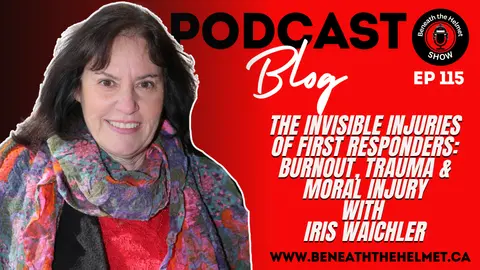
One moment in this conversation hits hard. Iris Waichler is describing a night she spent six straight hours in an emergency room with a family whose baby had died of SIDS. She stayed because she promised herself she would not leave a second sooner than they needed her to. When she finally drove home, in the dark, on a quiet road, she thought she saw a baby lying in front of her car. She slammed on the brakes. It was a doll, left in a pool of oil by someone filming nearby. She got out of her car and sobbed.
That story is not in this episode to shock you. It is here because it says something true about the people who do this work, the first responders on the call and the people who show up around them afterward. The weight does not stay at the scene. It rides home with you.
I sat down with Iris for this episode of Beneath the Helmet because she has spent over forty years as a clinical social worker, much of it on a hospital physical medicine and rehab unit surrounded by burn patients, amputees, and stroke survivors, before turning her attention to first responders and their families. Her book, Burned Out, was born on a porch, over a beer, with a firefighter neighbour who had been carrying stories for thirty years and finally had somewhere to put them. From there, she interviewed firefighters, EMTs, paramedics, and their families across the country, and what she brought back is honest, specific, and useful.
We talked about the difference between burnout and trauma, and why that distinction actually matters for how you respond to it. We talked about moral injury, a term I did not have language for until years after I retired, even though I now believe it was the root of my own burnout. We talked about how men and women in this profession tend to carry stress differently, how families read the warning signs long before the first responder is ready to name them, and how the hero label so many of us wear can quietly make it harder to ask for help.
If you have ever sat outside your own house in your truck before walking in the door, if you have ever decided not to tell your partner about the call because you did not want them to worry, if you have ever wondered whether what you are feeling counts as a real problem or an expected part of the job, this conversation was built for you.
Here is what stayed with me most.
Five Nuggets From This Conversation
Burnout and trauma are not the same problem, and they do not call for the same response. Iris describes burnout as the slow erosion that shows up when you start telling yourself you cannot keep going, when it bleeds into sleep, appetite, and relationships. Trauma is what accumulates from the calls themselves, the car accidents, the hazmat scenes, the ones that stack on top of each other. Naming which one you are dealing with is the first step toward doing something about it.
Moral injury is more common than the label suggests, and it can take years to recognize. Iris and I talked about the moments when you watch someone make a choice on the job that doesn't sit right with your values, and you cannot say anything about it in the moment. I did not have a name for this until I was writing my own book, years after it happened. Iris's research backs up how deeply this can settle into a person, and how much it matters to have language for it sooner rather than later.
Women and men in the fire service often carry stress differently. Iris found that women first responders tend to internalize difficulty more and are less likely to let their crew see them struggling, partly out of a need to prove themselves. At the same time, when women do acknowledge a problem, they tend to be more open to accepting help. Neither pattern is a flaw. Both are worth understanding, especially if you are leading a crew.
Families see it before you say it. Partners notice the irritability, the isolation, the changes in sleep and drinking long before a conversation happens. Iris's advice is to build a real agreement about how much of the job gets shared at home, and to have that conversation before things get to a crisis point, not after.
The hero label can be a trap. We talked about how society puts first responders on a pedestal, and how hard it is to raise your hand and say you are struggling when the story everyone tells about you is Superman or Superwoman. Iris agreed completely. Nobody is superhuman, and holding yourself to that standard is a quiet way of making sure you never ask for help.
This episode will not hand you a five-step plan and call it done. What it will do is remind you that you are not the only one who has sat outside your own house trying to figure out how to walk back in as a parent or a partner instead of the version of you the job asked you to be. Iris spent forty years in rooms where people's lives changed in a moment, and she chose to spend her time listening, then writing it down so the rest of us would not feel so alone in it.
Listen to the full conversation, and if it lands the way it landed for me, send it to someone who needs it. Subscribe to Beneath the Helmet at www.beneaththehelmet.ca so you do not miss what is coming next.
Yoga for Firefighters That Fits the Shift