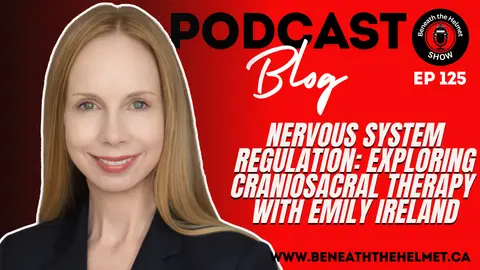
Nervous System Regulation: Exploring Craniosacral Therapy
There is a difference between a call being over and the body recognizing that the immediate demand has passed.
First responders understand this intuitively. A crew can return to the hall, finish the paperwork and start preparing for the next shift while the body remains tense, alert or unsettled. The circumstances have changed, but the body's pace may not have caught up.
That gap is a central idea in my conversation with Emily Ireland on Beneath the Helmet. Emily has worked in body-based practices for more than two decades, moving from Pilates and somatic movement into craniosacral therapy. She also created a product called Light Touch and founded the Hero Resilience Initiative.
We spoke about what it means to listen to the body, how practitioners present gentle-touch approaches, and where first responders might begin when they want a better relationship with their stress responses.
The call ends. Your system may still be working.
During an emergency, heightened attention, rapid decisions and physiological activation can be useful. Trouble can arise when that same level of readiness continues into moments that no longer require it.
Emily describes “relaxed alertness” as a useful way to describe the ability to stay present and capable without remaining in emergency mode all day. For first responders, this is not about becoming less effective. It is about having more flexibility between activation and recovery.
One part of our conversation stayed with me: the environment may be safe, yet the person may not feel safe. That experience deserves curiosity, not judgment. It also reminds us that what looks like irritability, distraction, or withdrawal should not automatically be treated as a character problem or a diagnosis.
Why body awareness matters
As a former fire chief and now a coach, I have seen how easy it is to prioritize the immediate task and overlook the body's signals. We can be skilled at noticing hazards, equipment limitations and changes in a scene while missing tension in our own shoulders, jaw or breath.
Listening to the body is not a vague demand to become more mindful. It can begin with a concrete question: What has changed in me since this morning? Perhaps your breathing is shallow, your posture is rigid, or your attention keeps returning to an earlier incident.
Emily suggests simple grounding exercises: noticing the chair's support, feeling your feet on the floor, and letting your attention rest briefly in the present. These practices are options, not tests of willpower. They may help some people and feel uncomfortable for others. Your own response matters.
What is craniosacral therapy?
Craniosacral therapy is a gentle-touch, hands-on approach that practitioners describe as working with the head, spine and sacral region. Emily explains that a session typically happens while a person remains fully clothed, with far less pressure than a deep-tissue massage.
The experience she describes is quiet and subtle, with room for the client to notice sensations, emotions or simply rest. She also discusses a concept called somatoemotional release, which she uses in her practice to describe connections between body sensations and emotional experience.
We should be precise about what that means. Feeling tension release, settling during a session or making emotional meaning of a physical sensation are personal experiences. Claims that craniosacral treatment physically repositions organs, resets the entire nervous system, or reliably treats specific conditions should not be taken as established based on a conversation or testimonial. The evidence for particular clinical benefits requires careful appraisal.
That does not mean we should dismiss someone's experience. It means we can honour personal reports without overstating what has been demonstrated.
A practical place to begin
You do not need to buy a device or book a session to start paying closer attention to yourself. Consider a brief check-in after a difficult call or before leaving work:
1. Notice contact: Where do your feet or body meet the ground or chair?
2. Notice change: Has your breath, muscle tension or attention shifted?
3. Choose one supportive response: Walk, stretch gently, breathe naturally, drink water, speak with someone you trust or seek professional support when needed.
4. Check again later: Did the choice help, do nothing, or make you feel worse? Let the answer guide the next step.
No single technique serves everyone, and a stressful response is not evidence of failure. The larger goal is to build awareness and choice, supported by a workplace culture that also takes workload, staffing, fatigue, leadership and recovery seriously.
The human behind the helmet
Our conversation with Emily invites us to look beyond performance and into the experience of the person carrying the work. Regulation is not about never feeling stress. It is about recognizing what is happening and finding appropriate, workable ways to respond.
Listen to Episode 125 of Beneath the Helmet, “Nervous System Regulation: Exploring Craniosacral Therapy,” to hear the full conversation. Emily can be reached at mylighttouch.com. As with any health-related practice or product, seek qualified advice for your own circumstances and evaluate treatment claims carefully.
*Beneath the Helmet | Mind. Body. Spirit. | The Human Behind the Helmet.*
The Firefighter Nervous System: Why Recovery Needs to Be Part of the Job