First Responder Moral Injury: When the Call Ends but the Impact Continues
Some calls stay with us. Sometimes because of what happened. Sometimes because of what we did, what we could not do, or what we were asked to carry afterward.
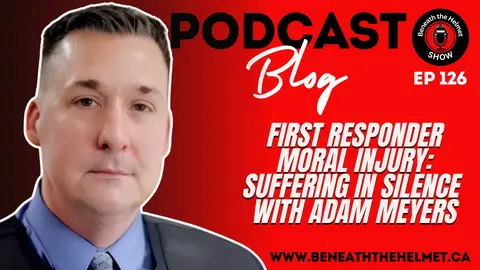
In this episode of Beneath the Helmet, I speak with Police Captain Adam Meyers. Adam describes a fatal critical incident in 2016 and the six years that followed before, in his words, he found the right kind of help. His account is deeply personal. It also raises important questions for fire, police, ambulance and other public safety organizations.
What does it mean when an incident has been investigated, and the member has been cleared, yet the person is still struggling? What happens when a return to work is treated as evidence that the difficult part is over? And what should leadership do beyond announcing that help is available?
A decision can be justified and still be difficult to live with
Adam describes responding to a call at a retail store that escalated rapidly. A person was armed with a hatchet. Adam fired his weapon. The person later died. He says the shooting was determined to be justified. Yet that conclusion did not end the personal impact.
One of the most important distinctions in this conversation is between an operational, legal or procedural conclusion and a person’s human experience. A finding that an action was justified does not, by itself, tell us how a person will make sense of it emotionally, socially or morally.
Adam uses the language of moral injury to describe some of his experience. He had grown up believing strongly in helping and protecting people. He also understood that using lethal force could be part of policing. Knowing both things did not remove the conflict he felt after a person died.
Moral injury is not the same as a PTSD diagnosis, and it does not have a single definition that explains everyone’s experience. In everyday terms, it can involve profound distress when events, actions or circumstances collide with deeply held values. Adam’s account shows why that distinction is worth exploring, without assuming that every first responder will understand their experience in the same way.
The struggle no one can see
Adam speaks about years of anxiety, depression and harmful coping. He discusses alcohol, drugs, relationships, shame and the sense that he needed to fix things on his own. He does not present those behaviours as acceptable or harmless. He describes their impact on himself and others, and his regret.
There is a difficult lesson here for colleagues and leaders. A person may keep showing up, performing aspects of the job, and appearing functional while their health or relationships deteriorate. Behaviour also needs to be addressed responsibly when it creates risks. Compassion does not mean ignoring safety, accountability or the wellbeing of others.
A more useful question is whether an organization can notice changes, respond fairly, reduce shame, and connect people with appropriate care before they reach a breaking point.
Returning to work is not the finish line
One of Adam’s strongest messages is that he wanted people to keep checking in. After the shooting, he was cleared and returned to work. He describes sensing that others thought the matter was finished: he was back, so he must be okay. In his experience, that assumption missed what he was living through.
An early check-in matters. So do the ones that come later. A thoughtful approach can include follow-up after the immediate incident response, during time away, after a return to work, and at meaningful later points. These conversations need privacy and consent. They should not pressure people to tell the story of an event or disclose clinical details to a supervisor.
A leader can still ask straightforward questions: How has work been feeling lately? Is anything making your day harder than it needs to be? Would it help to connect with someone outside the chain of command? What support would you prefer, and what would you rather keep private?
What matters is the quality of the relationship and what happens after the question. If someone does share a need, the organization must be prepared to respond within its responsibilities and limitations.
When colleagues go quiet
Adam also describes being deeply hurt when former colleagues stopped contacting him during his leave and after his termination. He had shared years of difficult calls and friendship with those people. Their silence left him feeling more alone.
We cannot know why every person did not reach out. They may have been uncertain, uncomfortable, constrained by workplace circumstances or unsure whether contact was welcome. But uncertainty is not a reason to abandon care.
A simple private note can be a start: “I’ve been thinking about you. There’s no pressure to respond. If you’d like to talk or grab a coffee, I’m here.” If someone says they don't want contact, respect that boundary. Otherwise, a gentle, occasional follow-up can communicate something meaningful: you have not been forgotten.
Recovery is personal, and leaders can help create the conditions
Adam describes therapy, medication, family support and a new police department as important in his recovery. Those were elements of his path, not a universal recipe. Other people may need different supports, timelines or career decisions.
He speaks warmly about the chief in his current department, who acknowledged that returning to a Walmart could bring up difficult memories and offered support without waiting for a crisis. That small moment demonstrates a form of leadership worth noticing: the chief remembered the person behind the uniform.
Later in the conversation, Adam imagines how he would respond if an officer in his care went through something similar. He talks about listening without judgment, meeting people where they are, and allowing support to continue. These are not costly interventions. They do, however, require intention, follow-through and trust.
A practical leadership reflection
We cannot guarantee that a person will be ready to talk. We cannot solve every challenge through a conversation, and peer support is not a substitute for qualified clinical care. We can create conditions that make support easier to access and less risky to request.
A few questions are worth taking back to the station, hall or leadership team. Do we know who reaches out after a difficult call? Do we check again when the immediate attention has faded? Are people clear about what is confidential and what must be acted on for safety? Can a member access care without feeling they need to disclose everything to their boss? Do our words about mental health match how we treat people who actually struggle?
Those questions move us beyond awareness campaigns and into everyday leadership practice.
Adam’s story is not a claim that everyone will struggle as he did. It reminds us that we often cannot see the full weight of an experience from the outside. We can choose not to make people carry that uncertainty alone.
Beneath the Helmet | Mind. Body. Spirit. | The Human Behind the Helmet.
Nervous System Regulation: Exploring Craniosacral Therapy