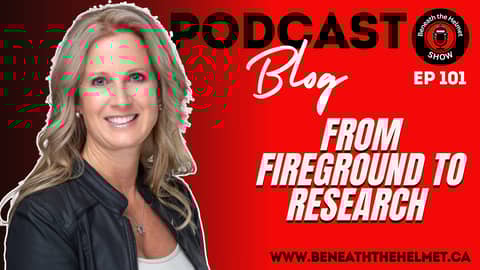
From Fireground to Research: Annette Zapp on Translating Science into Firefighter Wellness
Firefighters are trained to rely on evidence. Numbers matter. Data matters. Outcomes matter. Yet for decades, much of firefighter health and wellness has been shaped by tradition, habit, and well-intended dogma rather than science.
In Episode 101 of Beneath the Helmet, I sat down with retired fire officer and Fire Rescue Wellness founder Annette Zapp (AZ) to explore a powerful shift now underway in the fire service. One that moves us from “this is how we’ve always done it” to “this is what the science actually tells us.”
Annette brings a rare perspective. She lived the job. She understands the culture. And she is now deep in the research, dedicating her post-career life to translating science into language firefighters can actually use.
This conversation is about foundations. Sleep. Training. Hormones. Recovery. Decision-making. And why doing less, more consistently, often outperforms extreme approaches that burn people out.
Annette’s journey began in the fire service in 2004, where she noticed early on that some commonly accepted practices simply did not line up with science. Over time, that curiosity grew into purpose.
After retiring, she uprooted her life and began a PhD program with a clear mission: help translate high-quality research into practical tools for firefighters. Not charts and graphs. Not academic language. Real-world meaning.
Throughout the episode, we explored why firefighters often struggle to connect health challenges to the job itself, how sleep quietly drives nearly every aspect of performance and wellness, and why random acts of fitness rarely translate into fireground readiness.
Annette also shared why storytelling matters more than statistics, how testosterone and hormones open important conversations, and why extreme “all-or-nothing” approaches often do more harm than good.
This was not a surface-level conversation. It was a grounded, honest look at what truly supports longevity in the fire service.
Here are my top five Nuggets from this powerful conversation.
1. Translating Research Matters More Than Producing It
Firefighter health research is growing rapidly, but the gap lies in translation. Annette emphasized that firefighters do not need more data. They need meaning.
Science becomes useful when it answers one question clearly: So what now?
When research is told as a story and connected to daily decisions, firefighters listen.
2. Sleep Is the Most Upstream Intervention
Sleep is not a luxury. It is the foundation.
According to Annette, sleep influences nutrition choices, motivation to train, mood, decision-making, and overall health. Without adequate sleep, every other pillar weakens.
One of the most practical insights was simple yet profound: if you do not have a bedtime, you do not have a plan. Firefighters may not control calls, but they can control when they go to bed.
3. Health Comes Before Performance
Many firefighters train hard but are not meeting even the minimum exercise levels recommended for health.
Annette made a critical distinction between:
Exercise for health
Training for performance
If health foundations are missing, performance gains are limited. Random workouts may build muscle or endurance, but they do not automatically improve fireground tasks. Intentional, progressive training does.
4. Creatine Is One of the Most Misunderstood Tools in Firefighter Wellness
Creatine is not a steroid. It is naturally produced in the body and widely researched.
Annette outlined its benefits clearly:
Improved strength and muscle mass
Cognitive support during sleep deprivation
Emerging benefits for mental health, bone health, and recovery
Potential support for heat tolerance and physiological stress
For firefighters working in sleep-deprived, high-heat environments, this conversation reframed creatine as a legitimate wellness tool rather than a fitness myth.
5. Extreme Approaches Undermine Long-Term Health
One of the most important themes of the episode was the danger of all-or-nothing thinking.
Firefighters often swing between extremes: intense discipline followed by total collapse. This cycle fuels shame, frustration, and disengagement.
Annette advocated for consistency over intensity. Small, repeatable actions sustained over time outperform short bursts of perfection that inevitably fail.
Middle ground is not weakness. It is sustainability.
You may also enjoy Episode 77 with Megan Lautz Titled: Applesauce to Protein Bars: A Guide For First Responder Nutrition
This conversation is a reminder that firefighter wellness does not require perfection. It requires awareness, education, and consistency.
If this episode resonated with you, here are three simple next steps:
Subscribe to Beneath the Helmet so you do not miss future conversations grounded in real firefighter experience and evidence-based insight
Share this episode with a colleague, officer, or crew member who cares about longevity in the job
Reflect honestly on your own foundations: sleep, recovery, training, and support
The fire service deserves wellness conversations rooted in science and delivered with respect for the culture. Annette Zapp is helping lead that shift.
And it is one worth paying attention to.
Stay well.
Firefighter Burnout and Recovery: Brad Robinson on Healing, Nervous System Regulation, and Life After the Fire Service