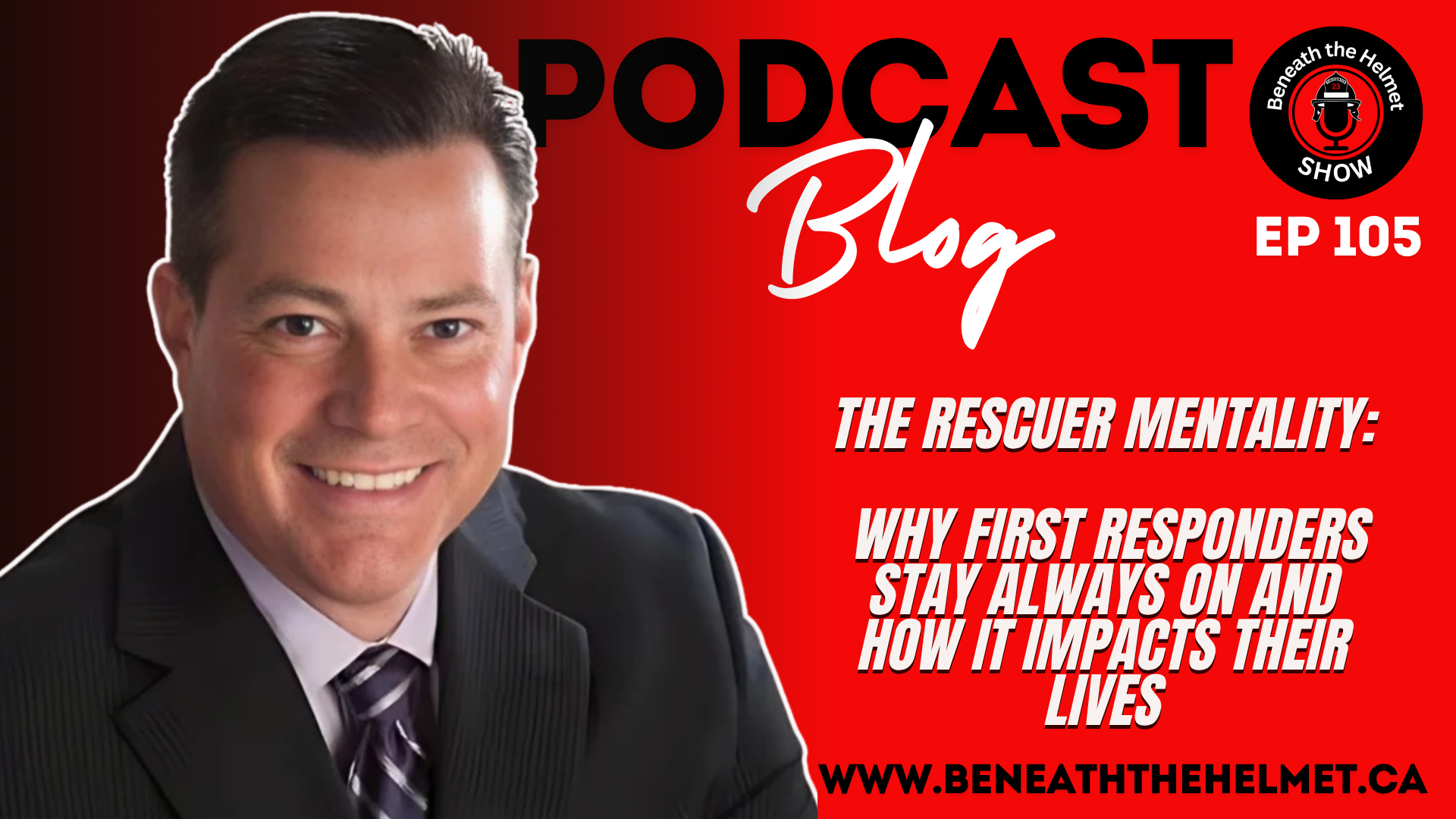
The Rescuer Mentality: Why First Responders Stay Always On and How It Impacts Their Lives
There’s a moment that happens quietly in the life of a first responder.
It’s not on a fireground.
It’s not at a call.
It’s not in the chaos.
It’s in the stillness.
You sit down. The shift is over. The noise is gone. And yet… your system is still running.
Still scanning.
Still bracing.
Still on.
That “always on” state is not a flaw. It’s not weakness. It’s not something broken.
It’s the rescuer mentality.
And over time, if it’s left unchecked, it becomes the very thing that starts to wear you down.
In this conversation with Dennis Carradin, a licensed mental health professional who has spent decades working with first responders, we pull back the curtain on what this mentality really is, where it comes from, and how it shapes your life both on and off the job.
Dennis doesn’t speak about this from theory. He’s lived it.
From volunteering as a firefighter and EMT to responding to major global incidents, his career has been immersed in trauma, crisis response, and the human side of the job.
And what he has seen over and over again is this:
First responders are wired differently.
“We have a need to be needed.”
That need drives performance. It pushes people into burning buildings, into chaos, into moments where others step back.
But it also creates a system that rarely shuts off.
- You’re not just responding to calls.
- You’re scanning environments.
- You’re anticipating risk.
- You’re preparing for what could go wrong.
Even at dinner.
Even at home.
Even when nothing is happening.
That’s the rescuer mentality at work.
The Cost of Being Always On
Here’s where it starts to shift.
That same mindset that makes someone exceptional on the job also creates pressure off the job.
Dennis describes it clearly.
You’re constantly on the move, constantly thinking, constantly anticipating… and when you stop, your brain goes to the most negative places.
This is where many first responders get caught.
You don’t slow down because slowing down doesn’t feel safe.
So you keep going.
Work. Train. Respond. Repeat.
Until the system starts to show signs.
- Poor sleep
- Chronic tension
- Irritability
- Emotional shutdown
- Loss of joy
And eventually, something deeper.
Why Decompression Gets Misunderstood
One of the most important insights from this conversation is the idea of decompression.
Most people think decompression is rest.
It’s not.
“That’s exhaustion… decompression is getting yourself reset.”
Decompression is awareness.
It’s checking in with your body.
Your breath.
Your thoughts.
It’s asking:
Am I regulated right now?
Or am I still carrying the last call?
Without that awareness, the stress doesn’t leave.
It stacks.
The Reality of the Job Most People Don’t See
The average person may experience a handful of critical incidents in a lifetime.
A first responder?
Thousands.
“In a career… you can see 4,000 critical incidents.”
That changes you.
It shapes how you think.
How you see the world.
How your nervous system operates.
And if there’s no intentional way to process that load, it starts to show up physically, mentally, and emotionally.
How It Follows You Home
One of the most overlooked parts of this conversation is what happens off duty.
You might not talk about the call.
You might think you’re protecting your family.
But your state still speaks.
Your partner can feel it… even when you say “I’m fine.”
That’s what Dennis calls trauma-adjacent stress.
They carry what you don’t say.
Not through details.
Through energy.
And over time, that creates distance.
The Long-Term Impact
This isn’t just about stress in the moment.
It’s about longevity.
Dennis doesn’t sugarcoat it.
This job ages you.
Not gradually.
Systemically.
From cortisol buildup to long-term health outcomes, the data points to a hard truth:
If nothing changes, the job takes a toll.
Physically.
Mentally.
Emotionally.
Top 5 Takeaways from This Conversation
1. The Rescuer Mentality Is Both a Strength and a Risk
That drive to help, fix, and respond is what makes great responders. It’s also what keeps the system running long after the call is over.
2. Decompression Is a Skill, Not a Break
Sitting down isn’t enough. Real decompression requires awareness, breath, and intentional reset.
3. You Can’t Outrun Stress by Staying Busy
Constant motion doesn’t resolve stress. It delays it. And eventually, it catches up.
4. You Don’t Have to Share Details to Be Honest
Saying “I had a tough call today” is enough. Authenticity builds connection without transferring trauma.
5. Seeking Support Is a Sign of Strength
Some of the strongest people are the ones willing to sit down and work through what they’ve carried.
Final Thought
There’s nothing wrong with being the one who shows up.
The one who runs toward the call.
The one who carries the weight.
But if you never learn how to put that weight down, even for a moment…
It will follow you everywhere.
So here’s a simple reflection:
When was the last time you were truly off?
✅Not distracted.
✅Not exhausted.
✅Not numbed out.
Actually off.
If this conversation resonated with you, take a moment to reflect on where you are right now and what you might need.
Then share this with someone in your crew, your department, or your circle who might need to hear it.
And if you’re not already following Beneath the Helmet, make sure to subscribe so you don’t miss future conversations on leadership, stress, and the human side of the job.
Stay well.
Arjuna George - Host
Firefighter Burnout and Recovery: Brad Robinson on Healing, Nervous System Regulation, and Life After the Fire Service