Talk About Talking: Connection Matters in First Responder Relationships
There’s a quiet reality in the first responder world that doesn’t get enough airtime.
It’s not the calls.
It’s not the shift work.
It’s not even the trauma.
It’s what happens at home.
The missed conversations. The unspoken expectations. The slow drift that can happen between two people who both care, but are living on completely different timelines.
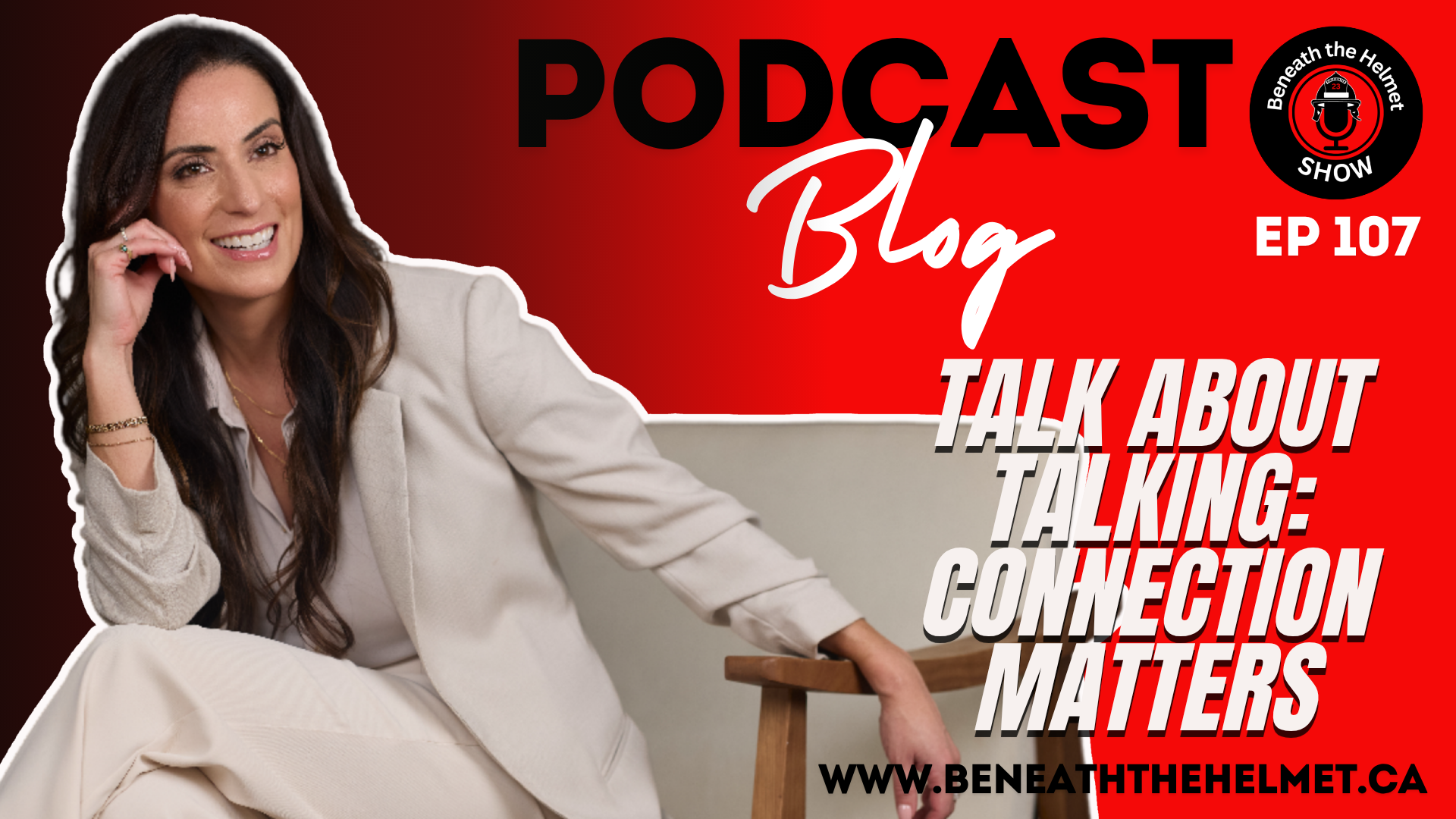
In this episode of Beneath the Helmet, I sit down with Dr. Kristy De Leon, a psychologist specializing in couples, intimacy, and first-responder families. What unfolded was an honest, grounded conversation about relationships under pressure and what it actually takes to stay connected.
If you’ve spent any time in the fire service or around it, you already know this:
The job doesn’t stay at the hall.
It follows you home.
In how you communicate.
In how you show up.
In what you avoid talking about.
And for the partner at home, they’re carrying their own load. Holding down the fort. Managing life while you’re away. Often, without a clear roadmap of how to stay connected through it all.
One of the most powerful ideas from this conversation was simple:
We don’t talk about how we talk.
We assume.
We react.
We communicate when we’re already overwhelmed.
And over time, that creates distance.
Why Relationships Struggle in High-Stress Careers
Dr. De Leon breaks it down clearly. Relationships don’t usually fail because of one big event.
They erode over time through:
- Repeated conflict with no resolution
- Misaligned expectations
- Emotional disconnection
- Lack of intentional communication
- Feeling like one person carries more of the load
When shift work enters the picture, it adds another layer.
One partner is operating in the intensity of the job.
The other is managing life at home.
Two different worlds. Two different timelines.
And when those worlds reconnect, it’s not always smooth.
The Hidden Impact of Language
There are phrases that seem harmless in the moment but land hard in a relationship.
Things like:
- “You’re being too sensitive.”
- “It’s not that big of a deal.”
They often come from a place of trying to fix or minimize stress.
But on the receiving end, they feel dismissive.
They shut the door on connection.
And over time, that builds resentment.
Conflict Isn’t the Problem
One of the most important reframes in this conversation:
Conflict isn’t bad. Repeated unresolved conflict is.
If you’re having the same argument over and over again, it’s a signal.
Something needs to shift.
That’s where intentionality comes in.
Not reacting in the moment.
Not avoiding the conversation.
But choosing when and how to engage.
Talk About Talking
This might be the most practical takeaway from the entire episode.
Talk about talking.
That means:
- When is the best time to have important conversations?
- What does your partner need when they’re overwhelmed?
- Do they want solutions, or do they want to be heard?
- How much detail is helpful when sharing difficult experiences?
Without these conversations, couples fall into patterns that don’t serve them.
With them, everything starts to shift.
Intimacy and Connection Matter More Than You Think
Another piece that often gets overlooked is intimacy.
Stress, trauma exposure, and fatigue all impact libido and connection.
And when intimacy drops off, it’s not just physical.
It creates a gap.
And as Dr. De Leon shared, when there’s a gap in a relationship, something will fill it. Good or bad.
That’s why it matters to stay curious instead of critical.
Not:
“Why don’t you want to have sex?”
But:
“I’ve noticed we haven’t been connecting the same way. Is there something I’m missing?”
That shift alone can change the direction of a conversation.
The Reality of Disconnection
One of the deeper insights in this episode is how disconnection builds.
It’s not always loud.
Sometimes it looks like:
- Watching shows together but not really connecting
- Avoiding difficult conversations
- Feeling like everything revolves around the job
- One partner feeling like they can’t take up space
And over time, that leads to something even more damaging.
Contempt.
That quiet frustration that shows up in tone, body language, and presence.
And once that sets in, the relationship starts to feel heavy.
Top 5 Nugget Takeaways from This Conversation
1. Talk About Talking
Don’t wait for conflict to define how you communicate. Decide together how and when important conversations happen.
2. Ask Better Questions
A simple question like, “How can I support you better?” can shift the entire dynamic of a relationship.
3. Manage Expectations Early
Unspoken expectations create tension. Clear, honest conversations create alignment.
4. Stay Curious, Not Critical
When something feels off, lead with curiosity instead of assumptions. It keeps the door open.
5. Be Intentional About Connection
Relationships don’t stay strong by accident. They require time, attention, and effort, especially in high-stress careers.
A Simple Reflection to Take With You
Ask your partner:
“Is there anything you’ve been wanting to share with me that we haven’t talked about yet?”
It’s a small question.
But it creates space for something meaningful.
If this conversation resonated with you, don’t keep it to yourself.
Share it with someone who needs to hear it.
Send it to your partner.
Start the conversation.
You may also enjoy episode 100, with podcast host Arjuna George, where he sits down with his family to discuss what it's like to grow up and be a partner of a first responder. The goods and the bads. Listen to it here.
And if you want more real, grounded discussions on leadership, wellness, and life in the fire service, make sure you subscribe to Beneath the Helmet.
Stay well.
Arjuna George - Podcast Host
www.beneaththehelmet.ca

“I’m Burnt Out”: The Realities of EMS and the Story Behind Code 3




